Some of you have already heard me rave about this, but for those who haven't, hold the phone: do you know about Habitat for Humanity's Restores?
Most folks have heard of Habitat for Humanity- the nonprofit that helps people build their own homes, revitalize neighborhoods, and teach general DIY skills to thousands of volunteers every year. It is a very established group- and for the record, I am in no way affiliated with them: I just can't resist giving them a plug because I see how much good they do in the world and I can't keep my mouth shut about it. Anyway... Habitat also runs over 6,000 Restores, and that is what I want to focus on in this post.
Restores are nonprofit stores that accept donations of used or surplus building materials (donators receive the necessary paperwork to file for a tax credit with the IRS), and they then sell these building materials for what often amounts to pennies on the dollar. Their goal? To make money that is all plowed back into their mission of sustainable, affordable housing and empowered homeowners who help to improve neighborhoods one house at a time.
We had a Restore when my wife & I lived in Madison, Wisconsin, and I was bummed when we relocated and Salt Lake didn't have one. Well, fast forward a few years, and now we do! I now have a place to donate my extra building materials- the amount of stuff they keep out of landfills every year is just staggering!- and it is also my first stop when I'm looking for materials for new projects around the house or shop.
So, my question is, where's your nearest Restore? And, have ya been lately? Let me know if you find any deals next time you go!
Here's a few pics from one of my recent (ok, I go every week!) trips:
Saturday, March 24, 2012
Saturday, March 10, 2012
Growing Up is Easy: for vegetables, anyway
Small space gardening is awesome- who doesn't want to get more produce from a given spot? Once you're up and running, it may actually be easier and more efficient to maintain than traditional garden plots. In fact, some small-space-friendly principles are just as useful to people who have a lot of room to grow stuff.
Growing vertically is a major theme in small-space gardening. While it is not exactly rocket science, I still want to devote at least one blog post to it, since it is one of those simple things that often provides the best results at the smallest expense of time, effort, and money. And it is overlooked far too often.
Vertical gardening takes advantage of the fact that most plants are really happy to grow upward if they are provided with some kind of structure to climb. That's my main point; I could stop writing now, but I won't, so stay tuned for more detail. Lots of plants can do fine when they are left to sprawl across the ground, and if this approach works for you in a particular situation, then that's great. Move along and enjoy the rest of your day! If you're interested, however, here are three reasons (there are more, of course) why vertical gardening makes sense:
1) Healthier plants
Some plants will be healthier when they are kept up off of the ground- this approach helps ensure a good airflow around the base of the plants, which can help excess moisture to evaporate rather than provide a breeding ground for mold, disease, and who knows what else. It also provides less nooks and crannies for mice, insects, and other pests to hang out.
2) Larger yields
Some plants will grow and grow and grow when they're given the opportunity, so if you build a simple trellis (it can be quick & dirty or fancy, or somewhere in between. Whatever works.)... your plants will get bigger and you might just get more produce. Logical, right?
3) Better produce with less waste
1) Healthier plants
Some plants will be healthier when they are kept up off of the ground- this approach helps ensure a good airflow around the base of the plants, which can help excess moisture to evaporate rather than provide a breeding ground for mold, disease, and who knows what else. It also provides less nooks and crannies for mice, insects, and other pests to hang out.
2) Larger yields
Some plants will grow and grow and grow when they're given the opportunity, so if you build a simple trellis (it can be quick & dirty or fancy, or somewhere in between. Whatever works.)... your plants will get bigger and you might just get more produce. Logical, right?
3) Better produce with less waste
I got sick of finding over-ripe, mushy, maybe even inedible tomatoes that I missed the first time because they were buried under tons of foliage. I hate to waste food, and I'd rather pick stuff at its peak- this is easy when plants are grown up high and trellised out so you can easily see how things are ripening. A good trellis makes it easier to monitor the health of your plants and the ripeness of your coming harvest.
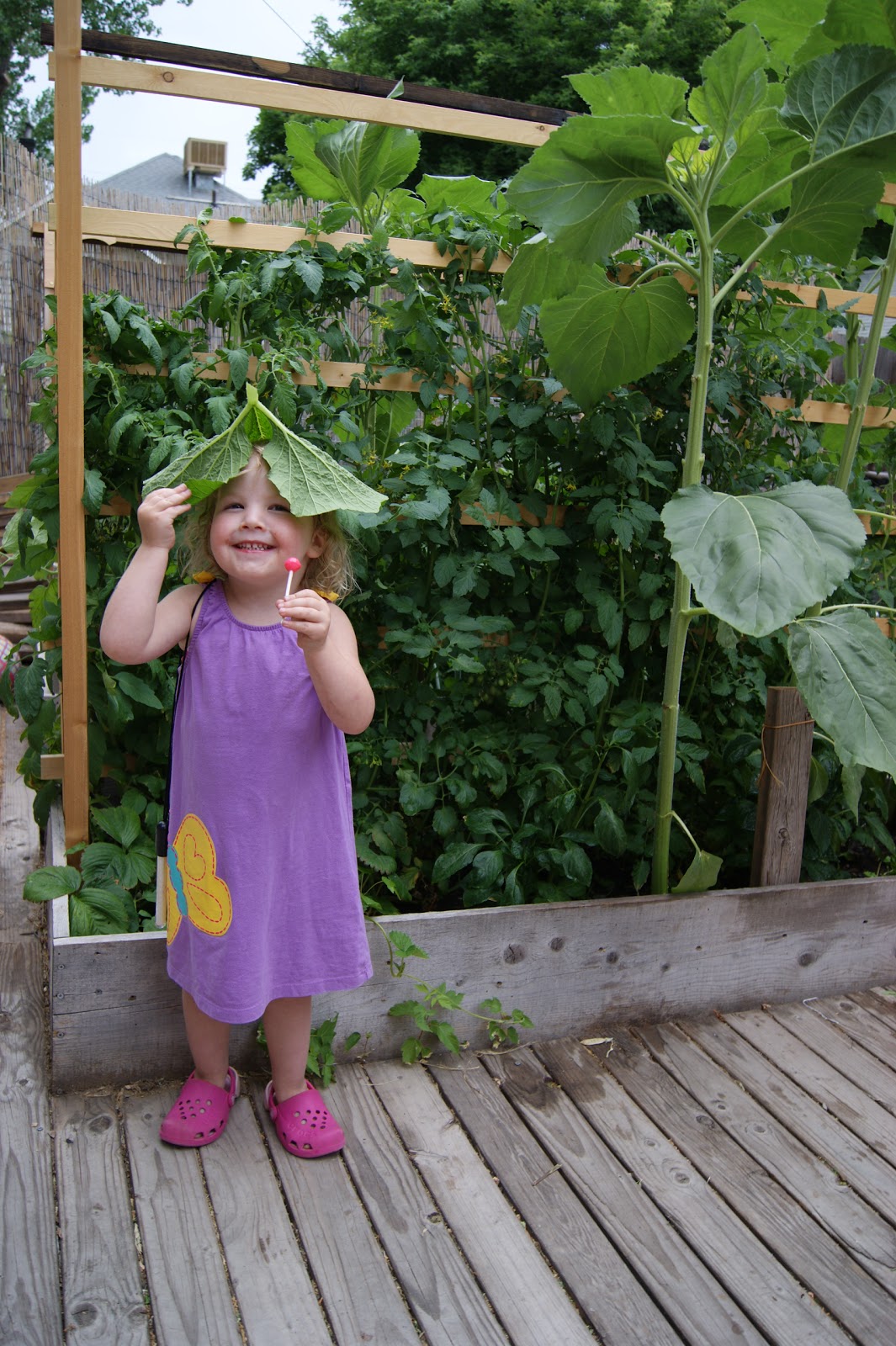
For example, I started out growing tomatoes in the ubiquitous wire cages that are about 3 feet tall. I did this for years, because that was the only way I knew how, and it worked out ok. But then I heard somebody- local superstar (in my book) Carly Gillespie, from Wasatch Community Gardens- talking about her tomato plants getting to 7 or 8 feet high, and I was blown away. Seduced by the promise of growing such whoppers, I came home and built a simple trellis- I mean really simple, just using scrap wood and about 20 minutes of my time. I built it 6 feet high, and when I planted my seedlings, it looked just ridiculous. "These plants will never get tall enough to need all this height," I thought. Boy was I ever wrong (I guess there's a first time for everything). Our plants blew past the 6 foot mark and I had to add on another foot of structure to the top of the trellis. This year, I'll be building a trellis 8 feet high.
In addition to looking awesome, our three "walls" of tomatoes provided far more produce than the old cages allowed for, and they made it easier to keep an eye on the ripening fruit so that they could be picked at their peak. While I didn't weigh the total amount of tomatoes we produced- I'm curious, but far too lazy- our 25 plants kept us in fresh tomatoes through December, and the gallons of fresh salsa I consumed (yes, gallons) were fantastic.
If you have any questions on building trellises or other supports, just ask!
Wednesday, March 7, 2012
Small Space Gardening
During the winter time, especially with Spring on the horizon but not actually here yet, even pictures of plants make me happy. This is a great time of year to start looking around and getting ideas about the upcoming growing season.
For many folks, space is an issue, either because there just isn't much of it, or it may not be around long enough (i.e. you're anticipating a move before you get to harvest those delicious veggies), and there are a few approaches that might help. Here I'll discuss my top 3, in no particular order:
*Container Gardnening
*Vertical Gardening
*Community Gardening
They're all pretty much just what they sound like, but since it is my nature to talk a lot, why stop now?
Container gardening
demonstrates that you can actually grow a lot in very little space (most "normal" gardens are not very space efficient, and I guess if you have a lot of room to spare, this may not matter, but why wouldn't you want to take an easier, more efficient route in life if there is no down side?) Just about all herbs are very well-suited to containers- they don't need deep soil or lots of room to spread out. Even a small balcony can house a very robust container garden. And when your plants are in containers, you can just load 'em up and take 'em with you if need be, or move them to other spots in the yard, or give them away.
You probably already have good containers on hand- old Rubbermaid tubs (even small ones just 6" deep) might work out great. You could also hit a thrift store and spend less than $10 for some funky containers that strike your fancy. Traditional flowerpots are fine if that's your thing, but once you start thinking about it, it is pretty easy to come up with solutions that look good and work great. Depending on the particulars, you may need to drill a few small holes in the bottom for drainage.
This post is inspiring me, in fact, to set a new goal for my own gardens this year: grow lots of stuff in other stuff. By which I mean that I'd like to go ahead and plant seedlings in as many things as I can that seem suitable. Obviously time, space, and sanity will have to limit the endeavor, but how's this for a motto: if there is a container of some sort laying around, I hereby vow to plant something in it!
For a really funny and practical take on this, here's a great blog I post I stumbled upon:
http://lifeonthebalcony.com/5-ways-to-create-an-ugly-balcony-vegetable-garden/
Stay tuned for a post later this week on vertical gardening. It was my big epiphany last year, and my 8' tall tomato plants were a thing of beauty. Talk about getting a lot of produce from a small footprint!
Warmly,
Chris Gleason
(photo credit keeping it real @ flickr.com)
For many folks, space is an issue, either because there just isn't much of it, or it may not be around long enough (i.e. you're anticipating a move before you get to harvest those delicious veggies), and there are a few approaches that might help. Here I'll discuss my top 3, in no particular order:
*Container Gardnening
*Vertical Gardening
*Community Gardening
They're all pretty much just what they sound like, but since it is my nature to talk a lot, why stop now?
Container gardening
demonstrates that you can actually grow a lot in very little space (most "normal" gardens are not very space efficient, and I guess if you have a lot of room to spare, this may not matter, but why wouldn't you want to take an easier, more efficient route in life if there is no down side?) Just about all herbs are very well-suited to containers- they don't need deep soil or lots of room to spread out. Even a small balcony can house a very robust container garden. And when your plants are in containers, you can just load 'em up and take 'em with you if need be, or move them to other spots in the yard, or give them away.
You probably already have good containers on hand- old Rubbermaid tubs (even small ones just 6" deep) might work out great. You could also hit a thrift store and spend less than $10 for some funky containers that strike your fancy. Traditional flowerpots are fine if that's your thing, but once you start thinking about it, it is pretty easy to come up with solutions that look good and work great. Depending on the particulars, you may need to drill a few small holes in the bottom for drainage.
This post is inspiring me, in fact, to set a new goal for my own gardens this year: grow lots of stuff in other stuff. By which I mean that I'd like to go ahead and plant seedlings in as many things as I can that seem suitable. Obviously time, space, and sanity will have to limit the endeavor, but how's this for a motto: if there is a container of some sort laying around, I hereby vow to plant something in it!
For a really funny and practical take on this, here's a great blog I post I stumbled upon:
http://lifeonthebalcony.com/5-ways-to-create-an-ugly-balcony-vegetable-garden/
Stay tuned for a post later this week on vertical gardening. It was my big epiphany last year, and my 8' tall tomato plants were a thing of beauty. Talk about getting a lot of produce from a small footprint!
Warmly,
Chris Gleason
Sunday, March 4, 2012
Handmade posters and more
I can not resist, as I sit here lazily surfing the web on a snowy Sunday morning, posting about this awesome artist I just found on Etsy. For those not familiar with Etsy, it is a pretty great online store dedicated to promoting the work of artists and craftspeople all over the world. And yes, there is some real goofy stuff on there, but if you look past it, it is absolutely full of some really terrific work.
Anyway, all of the posters at ChattyNora are hand-drawn (not printed, drawn! Sounds like a lot of work to me...) and the prices are really great, especially in light of the amount of work that must go into them. Here's the one that first caught my eye. It shall be mine, oh yes, it shall be mine:
There is also a really great Star Wars one which I am not quite geeky enough to buy, but still like anyway:

If you dig this style, take a look at their work. Not a bad way to spend a little time online:
-Gleason
Anyway, all of the posters at ChattyNora are hand-drawn (not printed, drawn! Sounds like a lot of work to me...) and the prices are really great, especially in light of the amount of work that must go into them. Here's the one that first caught my eye. It shall be mine, oh yes, it shall be mine:
There is also a really great Star Wars one which I am not quite geeky enough to buy, but still like anyway:

If you dig this style, take a look at their work. Not a bad way to spend a little time online:
-Gleason
Friday, March 2, 2012
Yard projects
This winter hasn't been a particularly tough one in Utah- it has actually kind of felt spring-like from time to time. Even though we just got whacked by a snowstorm, this has seemed more like the exception than the rule, and nothing can stop me from thinking about the cool stuff I just might get around to building for our yard and gardens this year. Every year, we add at least one raised bed, so there's that, and who knows what else we might come up with. What kinds of projects are you interested in building this year? And, even more to the point: how can I help? I am really happy to write blog posts that might help you in exactly this kind of endeavor. Please hit me up with any and all thoughts and suggestions! The best idea will win a signed copy of my new book "Building Projects for the Backyard Farmer", due out in April.
In the meantime, here's some pictures I took last summer (wow, it sure was green!) of things I'm inspired by:
Wednesday, February 29, 2012
Spring Chickens
Spring is in the air- or, at least on the calendar. Since tomorrow is March 1st, I've been thinking about this year's batch of chickens. I'm really looking forward to it. We've raised chickens for about 7 years now, and it is a ton of fun. One of the most satisfying things is seeing my young daughter (she's almost 4) get to interact with them and collect their eggs.
We've raised lots of chicks- purchased locally or online as day-old babies- and we've also purchased fully-grown birds here in town. Both approaches are really satisfying: the former provides the fun of watching the chicks grow, and the latter provides a pretty much immediate supply of fresh eggs. This year we'll be going with option #2.
Regardless of the approach you take to starting your backyard flock, they'll have to live somewhere. Building a chicken coop is a great DIY project if you're handy, or want to be. If not, you can probably find someone in your area to help you out.
Here's a couple of pictures of coops that I've built recently to help get your creative juices flowing.
We've raised lots of chicks- purchased locally or online as day-old babies- and we've also purchased fully-grown birds here in town. Both approaches are really satisfying: the former provides the fun of watching the chicks grow, and the latter provides a pretty much immediate supply of fresh eggs. This year we'll be going with option #2.
Regardless of the approach you take to starting your backyard flock, they'll have to live somewhere. Building a chicken coop is a great DIY project if you're handy, or want to be. If not, you can probably find someone in your area to help you out.
Here's a couple of pictures of coops that I've built recently to help get your creative juices flowing.
Monday, February 27, 2012
Planting seeds
I am excited to finally bring this blog to life. Thinking about it used to feel like a drag- oh man, another chore to do?- but now I have shifted to seeing it as a great source of joy that I can plug into. So what kinds of stuff will I be posting about, now that I've got my attitude adjusted?
+Music, especially opportunities to make and hear music in our area
+Food, from lots of different angles: growing it, preparing it, and consuming it
+Making stuff: nuts & bolts tips on building the things you want and much more
+People: our community is full of inspiring people that I want to spotlight. Stay tuned.
Thanks for reading this, and please give me a shout if you're inclined.
Warmly,
Chris Gleason
Sunday, February 26, 2012
My First Post!
Wow! I have been thinking about starting a blog for a few years now (who hasn’t?) but I held off because I figured the world didn’t need another “here’s what I had for dinner” kind of thing. And to be honest, even though I’m as much of a narcissist as the next guy, I guess I had mixed feelings about broadcasting so openly. I guess Facebook kicked the heck out of those inhibitions!
Fast forward to 2012: either something has changed online, or my perception has (maybe both?) and I have developed a new understanding of blogs as much more than just another forum for self-indulgence: the good ones seem to provide a really dynamic way of connecting with other people in a meaningful fashion. And that interests me very much. The name- which I agonized over, as I imagine most people do, evolved as a “close enough” representation of some of my dearest values: if life is a garden, we’re all planting seeds, all the time. And as a professional woodworker, sawdust is a by-product of my work that I then compost to nourish the plants that I grow. Call me an old hippie- you wouldn’t be wrong- but I think the name is going to stick, nonetheless.
Anyway, here’s what I am going to do: I plan to present myself, and some things that I find wonderful about this world, in an honest attempt to connect with a few people who may feel that it resonates with them. Wouldn’t that be grand, all by itself?
Warmly,
Chris Gleason
Subscribe to:
Posts (Atom)